
What We Do
In an effort to help promote Texas as a world-class destination for research, TAMEST hosts an annual conference, engages in educational programs on key issues and offers awards to provide recognition to aspiring Texas-based researchers. Our members are from universities, research organizations and industries throughout Texas.
TAMEST has held dozens of major events including annual conferences, critical issues forums and the Natural Hazards Summit. These events advance scientific research by providing forums for Texas’ science and technology leaders to explore opportunities for collaboration, share information with each other and recognize outstanding achievements within their scientific community.
These forums elevate Texas’ position as an important destination for scientific discovery and innovation internationally, and help ensure that our state attracts and retains the best minds in medicine, engineering and science.
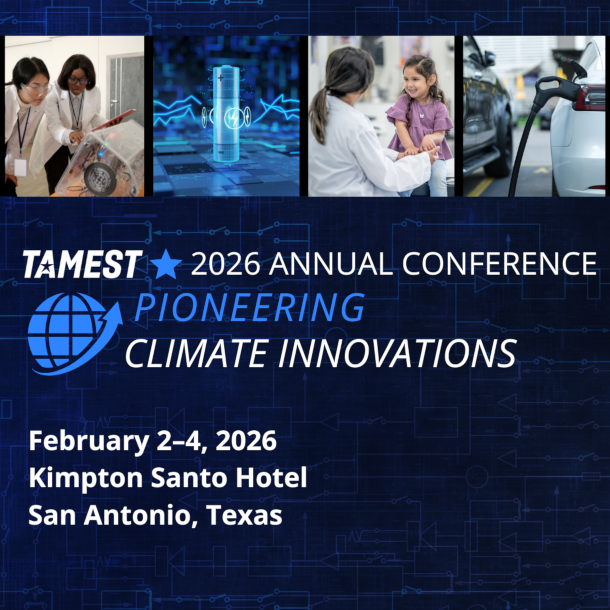
TAMEST 2026 Annual Conference: Pioneering Climate Innovations
February 2–4, 2026 | Kimpton Santo Hotel | San Antonio, Texas
The TAMEST 2026 Annual Conference: Pioneering Climate Innovations will showcase creative interventions and innovations in sustainability and climate resilience, adaptation and mitigation across a wide range of disciplines. Speakers and sessions will explore real-world, scalable climate solutions and collaborative problem-solving for sustainability in medicine, engineering, science and technology.
TAMEST 2025 Annual Conference: Transformational Breakthroughs
February 4–6, 2025 | Westin Irving Convention Center at Las Colinas | Irving, Texas
The TAMEST 2025 Annual Conference: Transformational Breakthroughs explored some of the most disruptive breakthroughs in science and technology set to change our way of life in the coming years. Speakers examined game-changing advancements in the fields of materials science and nanotechnology, exploration, regeneration and synthetic biology, energy transition and more.
TAMEST 2024 Annual Conference: Artificial Intelligence and Machine Learning
February 5–7, 2024 | AT&T Hotel and Conference Center | Austin, Texas
The TAMEST 2024 Annual Conference: Artificial Intelligence and Machine Learning explored the current practical and clinical use of AI/ML, examined its limitations and investigated its true potential for significant advancements in science and society. Speakers examined the challenges and opportunities of AI/ML in high-performance computing, defense, self-driving technology, precision medicine and health care delivery.
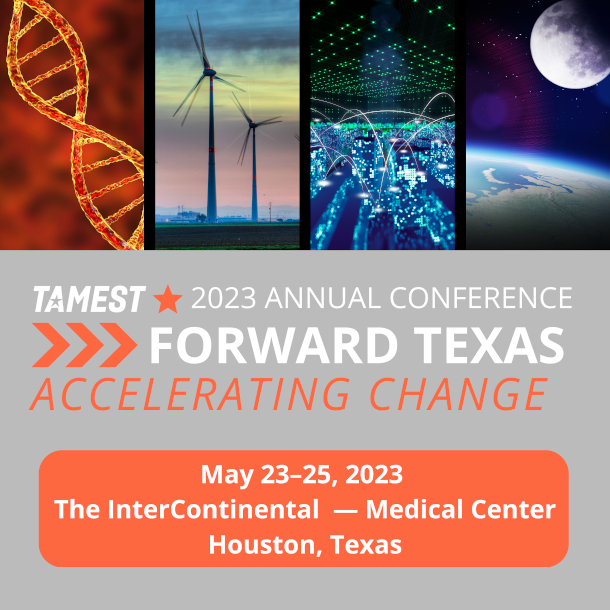
TAMEST 2023 Annual Conference: Forward Texas—Accelerating Change
May 23–25, 2023 | The InterContinental Houston – Medical Center | Houston, Texas
The TAMEST 2023 Annual Conference, Forward Texas: Accelerating Change, gathered some of our most celebrated and innovative researchers to examine how science and technology are leading to fundamental changes in society. The cross-disciplinary program focused on four profound scientific transitions underway: CRISPR gene editing, “big” data science, renewable energy and decarbonization.
TAMEST 2022 Annual Conference: Forward Texas—Imperatives for Health
June 20–22, 2022 | The Westin Riverwalk | San Antonio, Texas
The TAMEST 2022 Annual Conference, Forward Texas: Imperatives for Health, explored how Texas can build the vibrant, healthy communities of tomorrow and address topics like health care, education, infrastructure and infectious disease. It was also an important opportunity to examine the response to the COVID-19 pandemic, its long-term impacts on our communities and discuss the innovative solutions and interventions that happened as a result.
TAMEST Natural Hazards Summit: Responding to and Mitigating the Impacts
Part I | October 19, 2021 | Virtual
Part II | May 16, 2022 | Texas Tech University’s International Cultural Center | Lubbock, Texas
The TAMEST Natural Hazards Summit: Responding to and Mitigating the Impacts highlighted the influence of natural hazards on the economy and well-being of communities in Texas. The summit convened government officials, research leaders and insurance industry representatives, who took a hard look at what the state needs to know and do to prepare for future natural disasters, unprecedented weather events and global pandemics, including response, recovery and mitigation of the impacts.
TAMEST 2020 Annual Conference: Innovating Texas
January 7–9, 2020 | Fairmont Dallas | Dallas, Texas
The TAMEST 2020 Annual Conference: Innovating Texas explored how basic research leads to new technologies, products and companies and showcased avenues to commercialization for researchers across an array of disciplines. The program featured success stories from some of Texas’ greatest entrepreneurs and inventors and looked at astounding research and technology developments happening now that will impact our lives and economy in the future.
TAMEST 2019 Annual Conference: Neuroscience and Brain Health
January 14–16, 2019 | Horseshoe Bay Resort | Horseshoe Bay, Texas
The TAMEST 2019 Annual Conference convened some of the top minds in Texas and the nation to explore the groundbreaking research that could lead to advances in neuroscience and better brain health. We investigated topics such as healthy aging, addiction and the opioid crisis, neurological disease prevention, technological advances in mapping the brain, and neuroscience research priorities and challenges that lie ahead.
TAMEST 2018 Annual Conference: Aerospace
The 2018 Annual Conference: Aerospace explored the potential in Texas for greater research and development in aerospace, specifically in the areas of human space flight, aeronautics and commercial space exploration.
Texas’ top minds gathered on January 10–12, 2018, at the South Shore Harbour Resort and Conference Center in League City to explore what the future has in store for aerospace in Texas, the country and the world.


Studying the Impacts of Oil and Gas Development
A task force convened by TAMEST examined the environmental and community impacts of shale oil and gas development in Texas. The TAMEST Shale Task Force is a first-of-its-kind, comprehensive review of scientific research and related findings regarding impacts of shale oil and gas production in Texas.