
TAMEST Profile: Protégé Poster Challenge Grand Prize Winner Alexander Tatara, M.D., Ph.D., UT Southwestern Medical Center
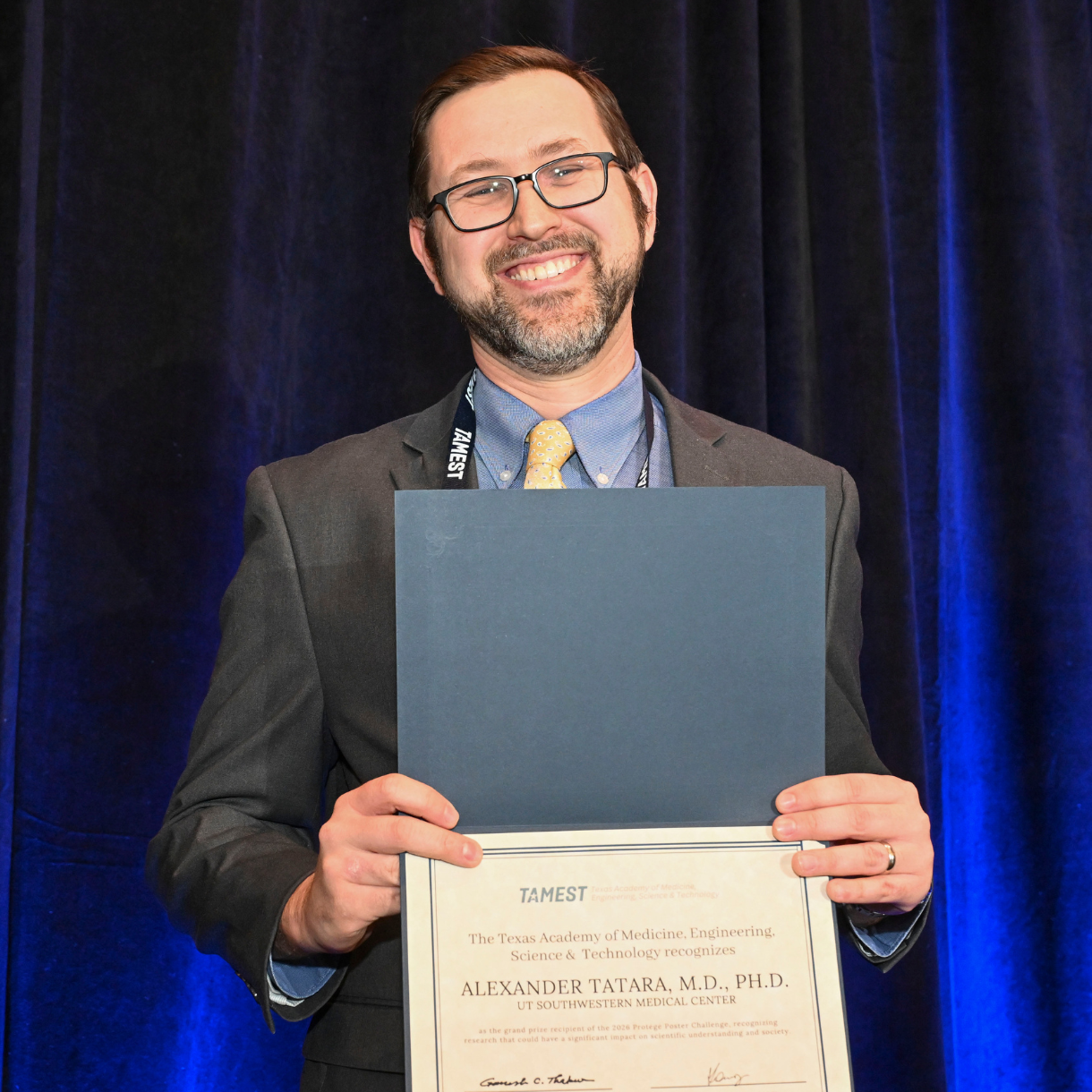
The Grand Prize Winner of the TAMEST Protégé Poster Challenge, Alexander Tatara, M.D., Ph.D. of UT Southwestern Medical Center, is part of a new generation of physician-scientists innovating bold ideas into real-world medical advances.
His poster, “Transforming Biomaterials into Antimicrobial Immunotherapy,” was selected from a strong group of 58 submissions to win the TAMEST Protégé Poster Challenge, sponsored by Shell, at the TAMEST 2026 Annual Conference. As one of four finalists, Dr. Tatara presented his research on stage and will receive $20,000 from Lyda Hill Philanthropies to further advance his work.
With dual training in medicine and research, Dr. Tatara brings a uniquely integrated perspective to his work in regenerative medicine and tissue engineering at UT Southwestern. His research reflects both scientific precision and a clear vision for clinical impact – a combination that stood out to the judges at this year’s poster challenge.
TAMEST connected with Dr. Tatara to learn more about the inspiration behind his research, the challenges and opportunities of translational science, and what this recognition from TAMEST means for his work moving forward.
Please tell us a little about yourself and your work.
I have the best job in the world – I get to help patients suffering from infections and run a laboratory program to better understand and treat infections using engineering tools.
I’m a physician-engineer who studies medical device infection. I was a student in the M.D./Ph.D. Medical Scientist Training Program at Baylor College of Medicine and did my Ph.D. in the Department of Biomedical Engineering at Rice University. I finished my clinical training in internal medicine and infectious diseases at Massachusetts General Hospital and did postdoctoral training at Harvard University. In the fall of 2024, my family and I returned to Texas, where I started as an Assistant Professor at UT Southwestern Medical Center.
How did you first hear about TAMEST and its Protégé Program?
I am fortunate to have done my Ph.D. training under the mentorship of TAMEST Member Antonios Mikos, Ph.D. (NAM, NAE), of Rice University. Dr. Mikos was previously a TAMEST protégé himself as well as the 2007 Edith and Peter O’Donnell Award in Engineering recipient. He is now a member of the National Academy of Engineering and National Academy of Medicine. He introduced me to TAMEST and nominated me to the Protégé Program.
What made you decide to participate in our poster challenge?
Once invited, I couldn’t pass up on the incredible opportunity to share my science with some of my scientific role models and heroes across the state.
Your poster was entitled, “Transforming Biomaterials into Antimicrobial Immunotherapy.” Tell us about your findings.
My laboratory has been interested in how we can use biomaterials to stimulate immune cells. Traditional vaccines in a liquid suspension have not been effective against Staphylococcus aureus, a bacterium that commonly causes infection (including its resistant form, methicillin-resistant S. aureus or MRSA).
We are studying how presenting the ingredients found in vaccines, such as antigens and adjuvants, in an implantable biomaterial scaffold changes how the immune system processes these ingredients.
In a rigorous animal model of an infected orthopaedic device, our biomaterial immunotherapy was able to significantly reduce the burden of bacteria by over 200x compared to a conventional vaccine. My laboratory is continuing to refine biomaterial immunotherapy and study which immune pathways we can better activate to provide protection.
What makes you most passionate about your work?
People make me most passionate about my work – both the people that we treat in our hospitals at UT Southwestern and the people that I get to train in my laboratory.
It is really humbling to learn from our patients and to hear what bothers them the most during their illness. These insights help fuel directions in our laboratory and can turn into some of our most exciting projects. In addition to patients, I’m really grateful to the people in my laboratory. We are so lucky to have a wonderful group of students and scientists who are brilliant, passionate and motivated to study medical device infection and biomaterial immunotherapy.
Talk about the research connections you made while attending the TAMEST conference and participating in the poster challenge.
It was so much fun to participate in the poster challenge and learn about all sorts of fascinating projects!
My poster was between Dr. Tracy Lohr, a gifted chemical catalyst researcher at Shell in Houston, and Dr. Aaryani Tipirneni-Sajja, an Associate Professor at the University of Houston studying magnetic resonance spectroscopy biomarkers – it was an absolute blast to learn about their science and illustrates the breadth of the Protégé Program.
I was able to reconnect with old friends, like Dr. Robert Seilheimer who is doing really interesting deep brain stimulator research at The University of Texas at Austin, and form new connections with colleagues like Dr. Shelly Buffington at Baylor College of Medicine who presented an absolutely brilliant poster at the interface of parasitic infection, maternal/fetal health and neuroscience. We are fortunate to have so much young talent across the state.
As a finalist, you were able to present your research on our conference stage. What was that experience like?
It was really exciting. The audience included scientists that I have admired since I was a medical student, as well as Nobel prize winners, department chairs and leaders in industry. It was intimidating to speak to such an accomplished group, but everyone was very kind and gave great feedback afterwards.
Many former TAMEST protégés have gone on to National Academy election. Did participating in this program help make that goal seem more attainable?
Absolutely. The mentorship I received at TAMEST as a young faculty who aspires to do research worthy of academy election was incredible. I’ve been blessed with amazing mentors throughout my training, including Dr. Antonios Mikos (Rice University), Dr. Dimitrios Kontoyiannias (MD Anderson), Dr. Sandra Nelson (Massachusetts General Hospital) and Dr. David Mooney (Harvard University). TAMEST gave me the opportunity to get feedback from other fantastic scientists and learn about the stories of their careers. Common themes were perseverance and kindness.
What do you enjoy doing outside of your research?
I love spending time with my wife and two daughters (Evelyn, four years old and Audrey, two years old). I enjoy playing banjo and cheering for the Houston Rockets.