
TAMEST Member News Roundup – June 2026
TAMEST loves to share the accolades of our membership. If you have been nominated for an award, been interviewed by the media or otherwise have a reason to celebrate, please share your news with TAMEST.
TAMEST In The News
Forbes: The Career Skills AI Can’t Replace, According To AMD CEO Lisa Su, TAMEST Member Lisa T. Su, Ph.D. (NAE), AMD
Nature: ToxiTaRGET: A Multi-Omics Database for Toxicant-Responsive Molecular Targets, TAMEST Board Vice President Cheryl Lyn Walker, Ph.D. (NAM), Baylor College of Medicine
Bioengineer: How Atlantic Herring Rewired Their Reproductive Strategy to Thrive in Changing Oceans, TAMEST Member Leif Andersson, Ph.D. (NAS), Texas A&M University
ISSUES: When Sixth Graders Study Neuroscience, Baylor College of Medicine
Biz Journals: Texas Biomed Launches $83M Center to Triple Its Biosafety Research Capacity, Texas Biomedical Research Institute President Larry Schlesinger, M.D.
Newswise: CPRIT Awards More Than $6M to UTHealth Houston Researchers, Cancer Prevention and Research Institute of Texas (CPRIT) and UTHealth Houston
KHOU: UT MD Anderson Cancer Center Gets Approval for $2.9B Expansion, Planning One of TMC’s Largest Buildings, The University of Texas MD Anderson Cancer Center
Dallas Innovates: Three Life Sciences Companies Expand Pegasus Park Presence to Tower’s Top Floor, 2025 Kay Bailey Hutchison Distinguished Service Award Recipient Lyda Hill and Lyda Hill Philanthropies
D Magazine: Meet the Dallas 500: Kirk Calhoun, UNT Health Fort Worth, UNT Health Fort Worth President Kirk A. Calhoun, M.D.
Member Briefs
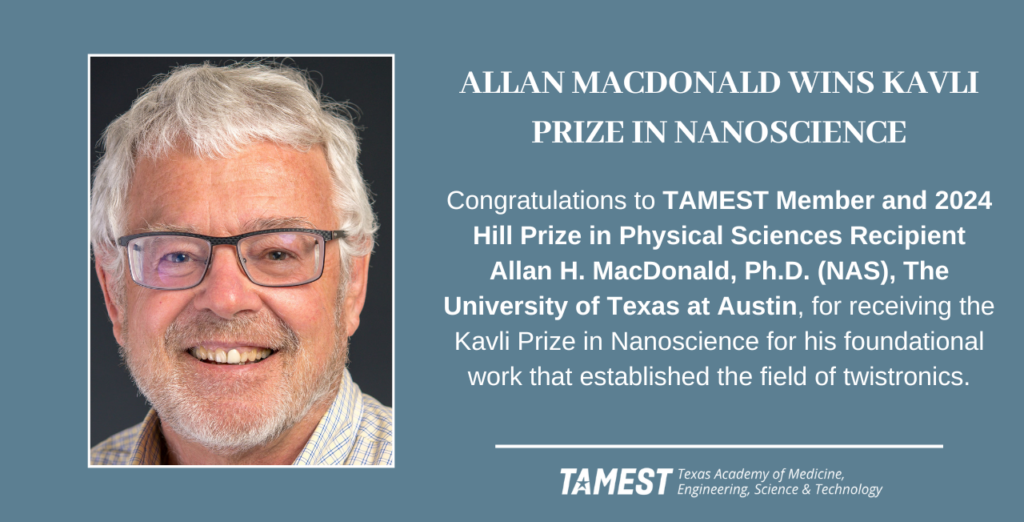
Allan MacDonald Wins Kavli Prize in Nanoscience
For the first time since the prestigious Kavli Prize was awarded in 2008 by The Norwegian Academy of Science and Letters, a Texas-based researcher has received the honor in the nanoscience category. TAMEST Member and 2024 Hill Prize in Physical Sciences Recipient Allan H. MacDonald, Ph.D. (NAS), The University of Texas at Austin, along with two other scientists, was recognized for foundational work that established the field of twistronics. This field is based on the idea that stacking two or more atomically thin layers of a material, such as graphene, on top of each other with a specific angular twist can unlock extraordinary new properties without changing the materials’ composition. The Kavli Prize honors scientists for breakthroughs in astrophysics, nanoscience and neuroscience – transforming our understanding of the big, the small and the complex. Read More
Martin G. Pomper Honored with 2026 Bayh-Dole American Innovator Award
Four members of the National Academy of Inventors, including TAMEST Member and TAMEST 2027 Annual Conference Science Co-Chair Martin G. Pomper, M.D., Ph.D. (NAM), UT Southwestern Medical Center, have been recognized with the 2026 American Innovator Award from the Bayh-Dole Coalition. The award honors innovators whose federally funded research has led to technologies and discoveries with significant societal and economic impact. Dr. Pomper was recognized for co-developing an FDA-approved imaging agent that significantly improved prostate cancer detection. Read More
Kaushik Rajashekara Elected into the Canadian Academy of Engineering
TAMEST Member and Hill Prize in Engineering Subcommittee Member Kaushik Rajashekara, Ph.D. (NAE), University of Houston, is one of only six International Fellows elected into the Canadian Academy of Engineering (CAE) in 2026. The CAE is Canada’s national institution through which individuals who have made outstanding contributions to engineering in Canada provide strategic advice on matters of critical importance to Canada and to Canadians. Read More
Maralice Conacci-Sorrell and Team Aim to Help People with Cancer Live Longer, Better Lives
Every year, roughly 2 million people in the United States are diagnosed with cancer. For TAMEST 2026 Mary Beth Maddox Award and Lectureship Recipient Maralice Conacci-Sorrell, Ph.D., UT Southwestern Medical Center, the number is not just a statistic; it’s personal. After both her mother and daughter faced cancer diagnoses, Dr. Sorrell dedicated her career to understanding the root causes of the disease. Her research has revealed how cancer cells harness nutrients to fuel their growth and led to targeted approaches for disrupting the process in difficult-to-treat cancers. Read More
The Texas A&M University System: Building to Lead in Space
The Texas A&M University System is quickly building one of the most expansive university-led space enterprises in the United States, which will be led by 2025 TAMEST Research Workshop Speaker Nancy Currie-Gregg, Ph.D., alongside TAMEST Member and TAMEST 2027 Annual Conference Technology Co-Chair Robert O. Ambrose, Ph.D. (NAE). The Texas A&M University Space Institute will be the centerpiece of the Texas A&M System’s growing space enterprise. Set to open in fall 2026, the first-of-its-kind research facility is rooted in collaboration, discovery and training, bringing government entities and private-sector partners together under one roof to perform space-related research side by side. Read More
New Era for Robot Autonomy: Rice Lab Delivers Tutorial at International Robotics Conference
Advancements in robotics are paramount to today’s technology revolution, increasing efficiency and automation across industries with applications in factories, warehouses, hospitals, on roadways and even at home. To ensure that robot systems can operate effectively to complete desired tasks and navigate dynamic environments, extensive motion planning capabilities are required — and researchers at Rice University, including TAMEST Member and Hill Prize in Artificial Intelligence Subcommittee Chair, Lydia E. Kavraki, Ph.D. (NAM, NAE, NAS), are at the forefront. Read More
Smarter Sensors Save Time and Energy
A team led by TAMEST Member Linda Katehi, Ph.D. (NAE) and Yuxuan Cosmi Lin, Ph.D., Texas A&M University, recently published the framework of their novel sensors called electrochromic hyperspectral embedding (ECHSE) that can compress and analyze their own data, saving time, money and energy. The system shifts intelligence from back-end computer analysis into the sensor itself, allowing for a reduction in data transfer while maintaining strong vision performance. Read More
The Cancer Prevention and Research Institute of Texas Awards More Than $103 Million in Cancer Grants; Expands Rural Clinical Trials
The governing board of the Cancer Prevention and Research Institute of Texas (CPRIT) has approved more than $103 million in 69 new cancer research and innovation grants for institutions and companies across Texas. The grants will expand rural clinical trials, support core facilities, fund childhood and adolescent cancer survivorship research, and help recruit and train the next generation of Texas scientists. These awards reflect CPRIT’s comprehensive approach to accelerating cancer cures and treatments and reducing the burden of cancer for Texans and Texas families. Read More
UT System Investments of Over $470 Million Accelerate UT San Antonio’s Rise as a World-Class Research University
The University of Texas System Board of Regents has authorized approximately $470 million in capital investments supporting UT San Antonio’s continued growth as one of the nation’s fastest-rising public research universities and academic health institutions. Approved over the past year, this series of investments spans the university’s academic and health campuses and supports major priorities in research, innovation, infrastructure, technology and patient care. Read More